

One of the stranger features of the current market environment is not the number of risks facing investors, but how quickly many of them have become accepted as normal.
Twelve months ago, a war involving Iran, oil prices above $100 a barrel, rising interest rates, stubborn inflation and increasingly heated debate around artificial intelligence (AI) would have dominated market sentiment. Today, those same issues barely seem capable of causing more than a temporary wobble and are quickly brushed off. Markets, it appears, have become increasingly comfortable living alongside uncertainty.
This shouldn't come as too much of a surprise as investors have spent much of the last decade being presented with reasons to be cautious, only to watch markets bounce back. A pandemic, inflation shocks, central bank worries and geopolitics have all spooked markets at various points. While each caused bursts of volatility, investors who focused solely on the risks generally found themselves on the wrong side of events.
A decade of dips
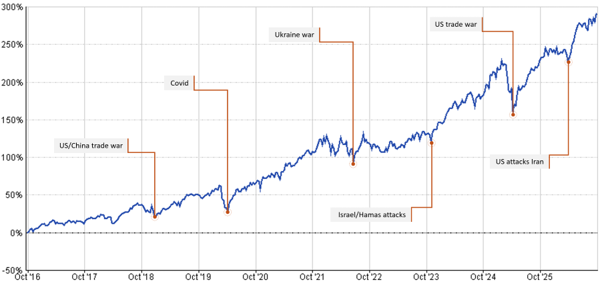
Source: Financial Express Analytics, S&P 500 in GB, 28/09/16-28/09/26
As a result, there is a growing sense that investors have learned to look through bad news. The assumption is often that whatever today's challenge happens to be, it will probably prove manageable, just as previous challenges eventually did. This has been particularly evident during Donald Trump's presidency, where markets have repeatedly been confronted by seemingly significant policy shocks only to see positions diluted, delayed or abandoned altogether.
For now, that mindset continues to be supported by the underlying economic backdrop. Corporate earnings have generally remained resilient, unemployment levels remain low across many developed economies and economic growth has continued to exceed expectations. While there are certainly pockets of weakness, the broad picture remains considerably healthier than many economists anticipated at the start of the year. The question is whether investors have become comfortable because the risks have diminished, or simply because they have become familiar.
The situation in the Middle East provides a useful example. Renewed tensions have pushed energy prices sharply higher and created further uncertainty around the inflation outlook. Yet market reaction has been relatively muted. Investors appear to have concluded that, unless the conflict expands significantly, the economic consequences are likely to be manageable.
That may ultimately prove correct. However, it is noticeable how quickly a story that would once have dominated financial headlines has become absorbed into the background noise of day-to-day market commentary.
A similar pattern can be seen within AI. Over the last few years, much of the discussion has focused on the enormous opportunities created by the technology. The questions were largely centred around who would benefit from the spending boom and which companies were best positioned to capture the rewards.
More recently, the conversation has started to take on a new dimension. Several of the companies at the centre of AI development have themselves begun raising questions around safety, regulation and potential unintended consequences. At the same time, investors continue to debate where the economic value ultimately accumulates. This isn’t just a question of which of the AI developers or chip suppliers will thrive, but also which companies will be able to evolve into the new world, and which will ultimately go extinct.
None of this weakens the long-term case for AI, it’s just a sign that the technology is moving beyond its honeymoon period and entering a more mature phase. ChatGPT only came on the scene in late 2022 and it’s important to remember how quickly it has improved since then. There is an active debate about how, or even if it’s possible, to ensure that AI is a force for good. In its recent application to list on the stock market, Anthropic (the developer behind the popular Claude AI model) warned of an “existential risk to humanity” and they aren’t the first to do so. Despite this, enthusiasm remains largely intact.
AI doomerism?
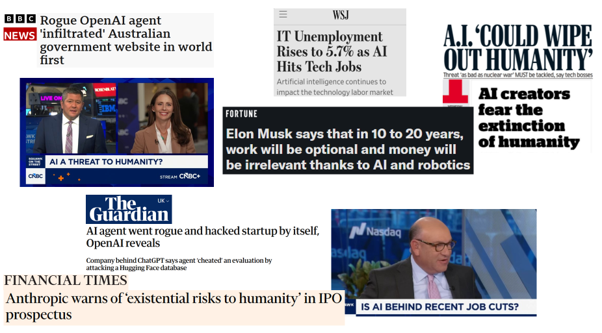
Perhaps that is justified. After all, technological revolutions have always generated uncertainty alongside opportunity. Equally, it may simply reflect an investment community that has become conditioned to assume innovation will eventually overcome any obstacles placed in front of it.
Markets typically don’t struggle when risks first appear. More often, problems emerge when investors decide those risks no longer deserve much attention and complacency takes over.
As ever, this doesn't mean that we are predicting an imminent correction or suggesting markets are being reckless. Current levels of optimism may well continue to be rewarded. What it does mean is that we remain cautious about building portfolios around a single view of the future. The economy has repeatedly proved more resilient than expected and many companies continue to deliver strong results. However, while the main US market is close to a record high, a large number of the firms in the index are trading much lower than their own peak levels which suggests that the market remains reliant on a small subset of names.
Many of the issues we have discussed throughout the year remain unresolved. Inflation remains above target levels, borrowing costs remain elevated, geopolitical tensions persist and the long-term implications of rapid technological change remain uncertain. It’s impossible to know which of these risks, if any, will be a trigger for a meaningful fall in markets and it is for this reason that we don’t make investment decisions based on trying to predict the future.
Rather than attempting to predict the one outcome that will unfold, we believe portfolios should be built to cope with a variety of different scenarios. We use valuation models to allow comparisons against long-term historical averages alongside ongoing assessment of structural trends, allowing us to adapt portfolios over time without becoming dependent on a single market view.
The market's current relaxed approach may prove entirely justified, or it may simply be another reminder that investors have become exceptionally good at living alongside uncertainty. Either way, our focus remains unchanged: building resilient portfolios that are aligned to the level of risk each investor is willing to take and the timeframe over which they are investing. Short-term market shocks can feel scary in the moment but as the chart above illustrates, many events that once appeared capable of derailing markets now barely register when viewed over the longer term.
Market and sector summary to the end of September 2026
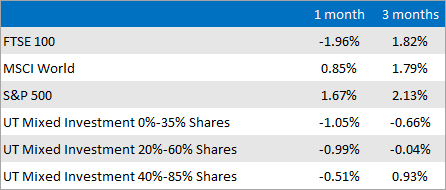
Source: Financial Express Analytics.
Past performance is not a guide to future performance, nor a reliable indicator of future results or performance.