

If you've read some of our recent updates, you'll know we've spent quite a lot of time discussing the disconnect between bond and equity markets. The latest company reporting season was another good example of why investors continue to be optimistic on the latter. US companies entered the period with expectations of roughly 9-10% revenue growth but results were closer to 15%, while earnings growth has generally exceeded forecasts. Importantly, strength has not been confined to the major tech firms, with positive surprises visible across much of the market. The broader economy has also continued to hold up better than many feared.
Against that backdrop, it's perhaps no surprise that many investors remain upbeat. One of the largest global fund manager surveys recently showed cash levels close to their lowest levels in decades and equity allocations near their highest level since the post-pandemic enthusiasm of 2021. Investors appear increasingly convinced that economic growth will remain resilient, earnings will continue to grow and central banks will be able to avoid hiking interest rates.
The problem is that government bond markets don't appear quite so optimistic.
Governments borrow money when their spending commitments exceed the amount they receive from taxation. To do so, they need investors to lend them money, and the interest rates they are having to offer have continued to move higher. In many developed markets, borrowing costs are now sitting around levels that, in some cases, haven't been seen for nearly twenty years.
Long term debt yields moving higher
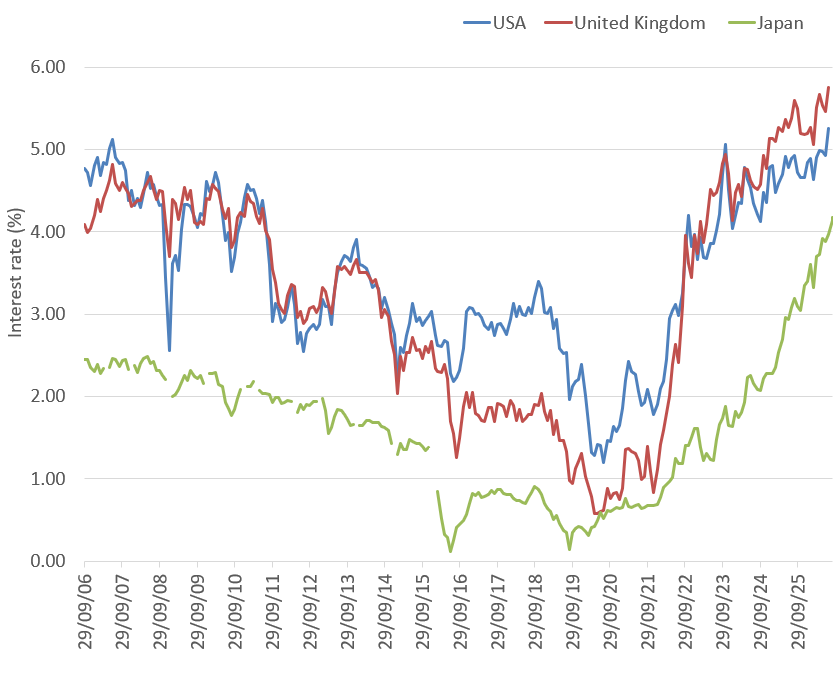
Source: FactSet, 30-year bond data (29/09/2006-01/09/2026)
That's important because governments are also carrying considerably more debt than they were a decade ago. The US national debt has doubled in the last ten years and when higher borrowing costs meet higher debt levels, things can quickly become uncomfortable. This increasingly feels like the issue bond markets are trying to highlight.
What we've been watching is the response from policymakers. At the start of August we saw another attempt to support the Japanese yen after the currency again came under pressure. One option available to Japan would have been to sell some of its holdings of US government bonds but that has the effect of pushing US borrowing costs even higher. This fear led to the first American intervention to support the Japanese currency since 1998, with the US selling some of its reserves of euros and buying yen in an attempt to support the currency without creating additional disruption in bond markets. The coordinated move helped the yen recover from its weakest levels, but only temporarily.
Later in the month the US Treasury stepped in again to purchase longer-dated US government bonds in the hope that this would calm markets and reduce pressure in the part of the market where borrowing costs have risen most sharply. By purchasing bonds, the Treasury was effectively creating an additional source of demand, the intention being to help support prices and pull yields lower.
This action doesn’t appear to have convinced investors. Yields have continued to move higher and the impression is that markets are increasingly looking through the symptoms and focusing on the underlying issue instead. One important element is that the purchase of longer-dated bonds is being funded by issuing short term debt. This comes with higher borrowing costs and is part of the reason that Donald Trump has been so keen for the Federal Reserve (Fed) to cut interest rates. This potentially puts the Fed on a collision course with the Treasury.
Speaking of Trump, when he was asked about the situation, he suggested military options should remain available. I have to confess I'm not entirely sure how that would work so we can probably ignore that option for the time being. Regardless, the focus on this topic illustrates that discussions about government borrowing and long-term debt sustainability are becoming more prominent, and rightly so.
Another area where the market narrative has become a little more complicated is artificial intelligence.
We've often spoken over the last couple of years about the enormous amount of money being committed to the technology with questions being asked about how that money was being spent. Who was building the data centres? Who was buying the chips? Which businesses were best positioned to support the rollout of the technology? More recently, investors have started asking a different question: where does the economic value ultimately end up?
That shift in thinking has already had an impact on markets. Earlier in the summer, some of the most crowded positions linked to the AI theme experienced one of their sharpest reversals for several years. More recently we've seen increasingly capable models emerging from China, often at significantly lower prices than their western counterparts. This doesn't necessarily weaken the investment case for artificial intelligence. If anything, cheaper and more accessible models could accelerate adoption. It does, however, make it less obvious where the eventual winners will be found.
The fall in the semiconductor (chipmaker) index is visible in the chart below. It shows that despite the recent drop, the index remains well above the most well-known tech names this year.
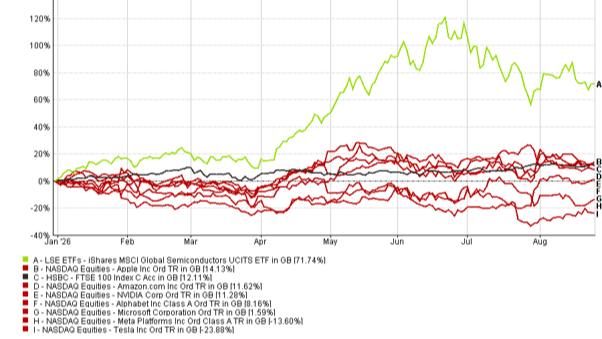
Source: Financial Express Analytics, year to 26th August 2026
As we've noted before, there is growing evidence that investors are becoming more selective. Many of the companies at the centre of the AI story continue to generate impressive profits yet share price reactions have become much less predictable than they were twelve months ago. Strong results are no longer always enough if investors were already expecting them. The debate increasingly feels less about whether AI becomes transformational and more about which parts of the value chain ultimately benefit when it does.
Alongside this, several of the issues we've discussed throughout the year remain unresolved. The situation in the Middle East has wobbled between periods of tentative calm and renewed tension. Oil prices remain below their peak levels but are still high enough that the potential impact on inflation should not be forgotten. Central banks continue to find themselves in the awkward position of wanting inflation to fall without causing unnecessary damage to economic growth by raising rates. Recent data showing higher inflation readings haven’t helped.
This creates an interesting contrast. On one side we’ve got a market focused on resilient economic growth caused by a technological revolution. On the other sits a bond market that seems rather less convinced that everything is quite so straightforward.
We aren't the first to point out that, in a disagreement between bonds and equities, it's usually worth paying attention to the message coming from bonds. That doesn't mean they're right and it certainly doesn't mean we're predicting an impending market correction. We've highlighted before that economies and companies have proved far more resilient than many expected. Markets can remain optimistic for far longer than seems reasonable and it is for this reason that it’s often riskier to bet against the tide continuing.
This explains why we continue to place such importance on diversification. If the outlook were genuinely as clear-cut as some investors seem to believe, portfolio construction would be a much easier job. The reality is that there are still plenty of moving parts beneath the surface. AI-led investment and resilient growth continue to create opportunities, but elevated borrowing costs, geopolitical uncertainty and inflation pressures all factor into our thinking.
As ever, our focus remains on building portfolios that can cope with a range of possible outcomes rather than trying to predict a single path for markets. Recent events have been another reminder that optimism and caution can exist side by side.
Market and sector summary to the end of August 2026
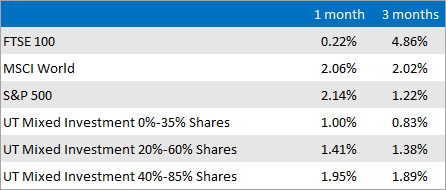
Source: Financial Express Analytics.
Past performance is not a guide to future performance, nor a reliable indicator of future results or performance.